4 Best SEO Tools I’m Using in 2026 (Free + Paid)
The SEO tools that worked in 2023 are not the tools you need in 2026. Here are the four I'm actually using to stay visible across Google, ChatGPT, Perplexity, and Claude.

Published May 1, 2026 · 8 min read · Updated May 2, 2026
As an agency owner, I've also worked with over 4,000 clients to help them with their SEO and AI optimization.
So it's safe to say that I've tested and used all of the best SEO tools on the market. And I'm constantly looking for the newest tools that can give me and my clients an edge.
In this post, I'm breaking down 7 of the best SEO software and tools (across different categories) so you can pick what's best for your specific needs. I'll also include an "ease of use" score for each tool (beginner, intermediate, or advanced) to help you choose tools that match your skill level.

Category: Content optimization & backlink building
Best for: Writing SEO/GEO-focused blogs
Ease of use: Beginner to intermediate
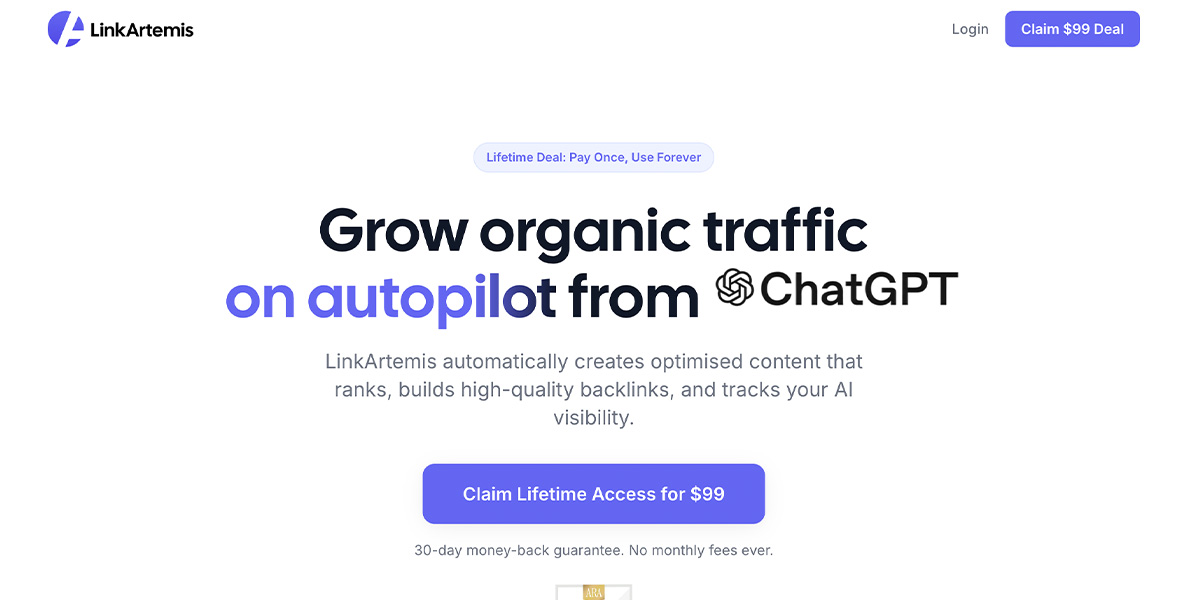
LinkArtemis is an SEO and content optimization tool that promises to help you boost your visibility in Google, ChatGPT, and other AI search engines. It's actually a tool that I've used for a while now, and I find it to be a staple in any SEO or content marketer's workflow stack.
How LinkArtemis works
At its core, LinkArtemis uses AI to generate SEO and AI optimized articles. It works by scraping through all the top-ranking web pages for a given keyword, and figures out what are common keywords used within those articles.
It then uses AI to write content for those keywords in your own brand voice. The key differentiator is what happens next. Every piece of content it creates is backed by an prospecting and outreach campaign that secures real backlinks from relevant sites. That means its publishing content and then building a backlink profile for that content.
Beyond that, LinkArtemis also tracks your AI visibility across ChatGPT, Perplexity and Claude. It uses that data to help find areas where you can improve and writes content to fill any gaps. It also has a Reddit Engine feature that finds high-intent Reddit threads in communities that AI crawlers actively monitor.
I recommend checking it out if you're looking for something that can handle your SEO and AI optimization from start to finish. Their lifetime deal is unbeatable and they have a 30-day money-back guarantee too, so there's no huge risk in trying it out.
Pros
- Lifetime $99 deal is unbeatable value
- The content generation is amazing. If you're looking to better optimize your content for SEO, it's an amazing feature.
- The real differentiator is its backlink prospecting and outreach tool. It generates the content then finds backlinks for it.
- It tracks your AI mention rate and visibility, then fills in content gaps.
- If you care about your brand voice, it is very good at writing like it
Cons
- Somethings can break at times because the team is constantly shipping new features. They are fast to respond though if you reach out.
Category: All-in-one SEO platform
Best for: Mid-size businesses and agencies serious about SEO
Ease of use: Intermediate to advanced
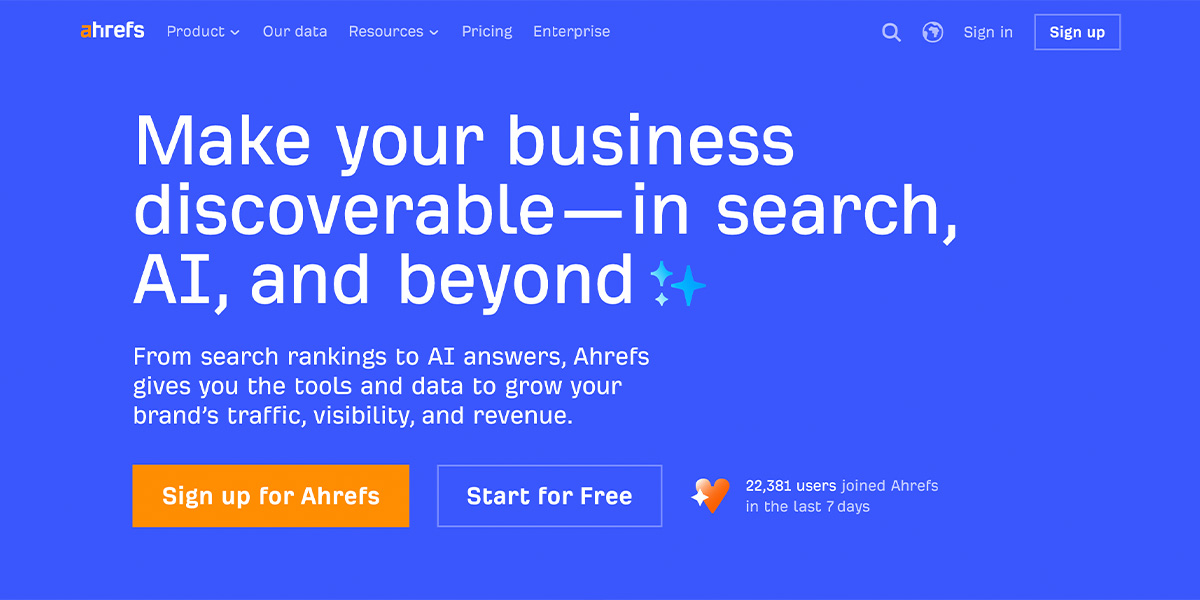
Ahrefs has been the gold standard for SEO research for years, and honestly, it still is. I've been using it on and off since 2017, and even with all the new AI-powered tools coming out, it remains the tool I trust most when I need real data on what's actually working in search.
How Ahrefs works
Ahrefs is built around three things they do better than anyone else: their backlink index, their keyword database, and their site audit tool. The backlink index is the largest in the industry by a significant margin, which matters because every other SEO decision flows from understanding who's linking to whom. When I want to figure out why a competitor is outranking me, Ahrefs is where I go first.
The keyword research tool gives you actual search volumes, click-through rate estimates, parent topics, and the ranking difficulty score that's become the industry shorthand. It's not perfect (no keyword tool is), but the data is consistently more accurate than anything else I've used.
Site Audit is the unsung hero. It crawls your site like Google would, flags every technical issue worth caring about, and tells you what to fix in priority order. I run it monthly across all my properties and it's caught more problems than I want to admit.
Beyond the core three, Ahrefs has expanded into rank tracking, content gap analysis, and now AI-powered features like AI Overviews tracking. Though, the AI features feel slightly bolted on compared to newer tools.
The honest catch is the price. At $129 a month for the Lite plan and $449 for the Advanced plan that most agencies actually need, Ahrefs is genuinely expensive. For a solo operator or small business, it can be hard to justify. But if you're running an agency or you have multiple sites where SEO matters, the data quality pays for itself.
Pros
- Largest backlink index in the industry, which makes competitive analysis genuinely useful
- Keyword data is more accurate than most competitors
- Mature product with stable features and reliable uptime
- Free tools (Ahrefs Webmaster Tools) are surprisingly generous if you verify your own site
Cons
- Expensive, especially when you outgrow the entry tier
- AI features feel reactive rather than native to the product
- Steep learning curve if you're new to SEO
Category: All-in-one SEO platform (budget tier)
Best for: SEO basics on a tight budget
Ease of use: Beginner to intermediate
SerpStat is the budget all-in-one option in this list. It covers most of the same ground as Ahrefs (keyword research, backlink analysis, rank tracking, site audit) at less than half the price. The catch is exactly what you'd expect when you pay less: the data quality isn't as good.
How SerpStat works
SerpStat tries to do everything. Keyword research, competitor analysis, backlink data, rank tracking, site audits, and a content marketing module are all included in the standard plan. On paper, it looks like Ahrefs at half the price.
In practice, the keyword database is smaller, the backlink index is less comprehensive, and the rank tracker is less accurate. It's not bad. It's just noticeably less reliable than the premium tools. I've used SerpStat in the past for client projects where the budget didn't stretch to Ahrefs, and it got the job done. Just not as confidently.
The UI feels a few years behind the rest of the industry. It works fine, but it's not pleasant. Reports can take longer to generate than competitors, and some features feel half-finished.
The strongest case for SerpStat is if you're a solo operator or a freelancer who needs basic SEO data and can't justify Ahrefs at $129/month. At $59/month, it's a reasonable entry point. Just go in knowing the data isn't quite as trustworthy, and verify anything important against another source before making decisions on it.
For agencies serving multiple clients, the price gap between SerpStat and Ahrefs disappears once you start hitting limits and need to upgrade. At that point, paying for the better data quality is worth it.
Pros
- Significantly cheaper than premium alternatives like Ahrefs
- Covers all the major SEO categories in one tool
- Decent for keyword research at the basic level
Cons
- Data quality is noticeably less reliable than premium tools
- UI feels dated and slow
- Some features feel underdeveloped compared to competitors
Best for: Every site owner, no exceptions
Category: Search performance monitoring
Best for: Understanding how Google sees your site
Search Console is Google's own tool for site owners, and it's free. If you're not using it, you're missing data that no third-party tool can fully replicate, because this data comes directly from Google.
How Search Console works
Once you verify your site (via DNS, an HTML tag, or Google Tag Manager), Search Console shows you exactly what Google sees when it crawls your site. Which pages are indexed. Which keywords your site is ranking for. How often your pages appear in search results. How often people click. Average ranking positions. Mobile usability issues. Core Web Vitals scores. Schema errors. The list goes on.
The Performance report is the most valuable feature for most people. You can see every keyword your site shows up for in Google, the actual position, click-through rate, and impressions. Third-party rank trackers estimate this data. GSC gives you the real numbers from Google itself.
The URL Inspection tool lets you see exactly how Google has crawled and indexed any specific page on your site, request reindexing, and check for issues that might be holding the page back. This alone is worth the time investment.
The Coverage report shows you every page Google knows about and whether it's indexed, blocked, or has errors. I've found pages on my own sites that were unintentionally noindexed, broken redirects that were eating crawl budget, and duplicate content issues I had no idea existed. None of this would have surfaced in third-party tools.
The honest catch is that Search Console isn't a complete SEO solution. It tells you what Google sees and how your site performs in Google search, but it doesn't help with keyword research, competitor analysis, or backlink tracking. That's why it's ranked lower despite the high score: it's essential, but it's not enough on its own.
Use it alongside one of the other tools in this list. Search Console for ground truth from Google. A paid tool for everything else.
Pros
- Free, with no usage limits
- Data comes directly from Google rather than estimates
- The Performance report is the single best source of real keyword ranking data
- URL Inspection lets you debug indexing issues no other tool can see
Cons
- Doesn't help with keyword research, competitor analysis, or backlink tracking
- Data is delayed by 1-2 days for most reports
- Only covers Google search, not Bing or AI tools
Is SEO still worth it in 2026?
Yes, but the rules have changed.
Three years ago, SEO was about outranking competitors on Google. Now it's about being visible across Google, ChatGPT, Perplexity, Claude, and whichever AI search tool replaces those by next year. The work is harder, the playing field is wider, and most of the advice on the internet is still calibrated for a world that doesn't exist anymore.
The good news: the sites winning right now aren't the ones with the biggest budgets. They're the ones writing from real experience, in their own voice, on topics they actually know. I outrank companies with marketing budgets bigger than my entire annual revenue, not because I'm clever about SEO, but because I've actually run the businesses I write about. Google can tell the difference. AI search engines can tell the difference even more clearly, because their entire job is to surface answers from sources worth trusting.
This is also why generic AI content doesn't rank anymore. Google's helpful content system is good at spotting articles that are summaries of other articles. AI search engines don't cite content that has nothing original to add. If your strategy is "use ChatGPT to write 50 blog posts a month and hope something sticks," it's already dead.
The strategy that works in 2026 is different. Write fewer articles, but write them from genuine experience. Use AI as a research and drafting tool, not a content factory. Track your visibility across both traditional search and AI search, because they're different battles now. Build the kind of site that AI engines want to cite when someone asks a real question.
That last part is exactly what LinkArtemis is built for. It's not a "generate 100 articles a week" tool. It's a tool for people who want to write content that actually ranks, with the AI search optimization layer that legacy SEO tools haven't caught up to yet. If you've made it this far in the article, it's probably the tool worth trying first.
The bigger point: SEO isn't dead, it just stopped rewarding shortcuts. The operators winning in 2026 are the ones who treated SEO like a long-term investment in being genuinely useful, not a hack to extract traffic from Google. Change the question from "what can I get out of search engines" to "what can I give them that nothing else does." That's the shift.
If you want more on this, I write about it weekly. The newsletter is below.
Business With AI
Editorial Team
Business With AI is the editorial team behind this site. We test AI tools on real client work, write up what we find, and call out what doesn't work as honestly as what does. No sponsored reviews. No content written by AI pretending to be human. Just practical guidance for small and mid-sized businesses trying to figure out where AI actually fits.
Related
DeepSeek V4 vs Claude Opus 4.7 vs GPT-5.5: I Tested All Three on Real Business Tasks
Three frontier AI models all launched within a week of each other. I decided to spend two days putting them through the kind of tasks small business owners a...